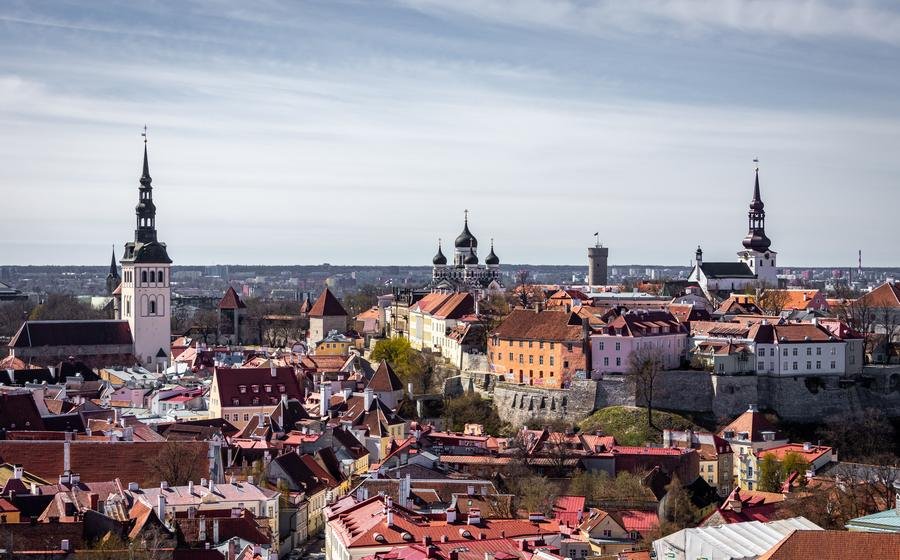
Bratislava lies around 60 kilometres from Vienna – apart from Rome and the Vatican, no two European capitals are closer together. Slovakia has used the euro since 2009 and fundamentally restructured its corporate taxation in 2025: small companies with revenue of up to €100,000 now pay just 10% corporate tax. Anyone considering company formation in Slovakia should also know two levies that neighbouring countries do not have in this form: the minimum tax and the financial transaction tax.
Three corporate tax tiers
Since the 2025 tax year, Slovak corporate tax has had three tiers based on taxable revenue:
| Annual revenue | Rate | Applies to |
|---|---|---|
| up to €100,000 | 10% | small companies |
| €100,001 to €5 million | 21% | medium-sized companies |
| above €5 million | 24% | large companies |
Dividends to individuals are subject to 7% withholding tax. Within the EU, distributions to parent companies holding at least 10% are tax-exempt under the Parent-Subsidiary Directive. Taxes are administered by the Slovak Financial Administration.
Minimum tax and transaction tax
Even without profit, every Slovak company pays a minimum tax. It starts at €340 for revenue up to €50,000 and rises in steps; for revenue above €5 million it reaches up to €11,520 since 2026. Especially in the start-up phase, this amount should be budgeted for.
Since 2025, Slovakia has also levied a financial transaction tax on payments made by businesses from Slovak bank accounts: 0.4% per debit, capped at €40 per transaction; cash withdrawals are charged at 0.8%. For companies with a few large payments the burden remains manageable; with many small transfers it adds up noticeably.
Legal form and bookkeeping
The usual legal form is the s.r.o., the Slovak limited liability company, with share capital of at least €5,000. For larger ventures there is the joint-stock company a.s. with share capital of at least €25,000.
For bookkeeping, Slovak companies keep double-entry books and file their annual accounts with the register of financial statements within six months of the end of the financial year. Accounting records must be kept for ten years.
VAT and wage levels
Since 2025, the standard VAT rate has been 23%, with reduced rates of 19% and 5%. A company must register with revenue above €50,000 from the following 1 January, and immediately above €62,500.
Wage levels also speak for the location: the statutory minimum wage in 2026 is €915 a month. For Austrian companies, Slovakia is therefore an obvious location for production, logistics and customer service – with the euro, EU law and short distances. Anyone planning company formation in Slovakia with staff will also find a dense supplier industry in western Slovakia, especially around the car plants.
Staff costs and participations
Anyone hiring staff should calculate staff costs carefully: according to the Forvis Mazars CEE Tax Guide 2026, employers in Slovakia pay social contributions of around 36% of gross salary. Employees‘ income tax is progressive and reaches up to 35% since 2026.
For participations in holding structures: dividends between companies in the EU are tax-free under the Parent-Subsidiary Directive if the holding is at least 10%. Distributions to individuals are subject to 7% withholding tax.
Formation step by step
Company formation in Slovakia proceeds step by step – the formation comprises five stages:
- Articles of association: with notarially certified signatures of the shareholders.
- Trade licence: registration of the planned activities with the trade register.
- Share capital: payment of at least €5,000 before registration.
- Registration: in the commercial register at the competent district court, electronically via the state portal slovensko.sk.
- Tax registration: with the Financial Administration and, if required, for VAT.
Registration usually takes one to two weeks.
Accounting and obligations
The key obligations for bookkeeping, accounts, audit and VAT at a glance – so you know from the start what running your company involves.
| Obligation | Rule |
|---|---|
| Bookkeeping | Double-entry bookkeeping; keep records for ten years |
| Annual accounts | Within six months with the register of financial statements |
| Tax return | Annual return; minimum tax from €340 |
| VAT: registration | From €50,000 from the following year, immediately from €62,500; rate 23% |
| Ongoing register duties | Financial transaction tax: 0.4% per debit, capped at €40 |
As of 2026. Bookkeeping and filings are usually handled by specialised accountants in the target country.
Is Slovakia right for you?
Whether Slovakia is right for you depends above all on revenue level and payment patterns:
Suitable for
- Small companies with revenue up to €100,000
- Manufacturers and suppliers with customers in Austria
- Companies that want the euro as currency
- Dividend recipients using the 7% withholding tax
Less suitable for
- Companies with many small bank transfers
- Large firms above €5 million revenue looking to save tax
- Founders planning without a minimum tax
- Consumer businesses sensitive to 23% VAT
With 10% corporate tax without a revenue limit and without a transaction tax, Bulgaria is the direct alternative in the eurozone; Hungary offers 9% right next door. The overview of all locations and the tax comparison help put things in context; detailed planning follows in the initial call.